When stress or anxiety is present, it can help to pause and give the mind something gentle to focus on. Guided visualisations are one way to do this. By imagining a peaceful place in detail, we can help the body soften, the breath slow, and the mind feel a little more settled.
This forest walk visualisation invites you to picture yourself moving through a calm, beautiful natural space — noticing the sights, sounds, scents and sensations around you.
In this article, we’ll explore what guided visualisation is, why it can be helpful, and share the forest walk visualisation in a simple format you can return to whenever you need a moment of calm.
What is a guided visualisation?
A guided visualisation is a relaxation technique that uses imagination to create a sense of calm and safety.
It usually involves imagining a peaceful scene — such as a forest, beach, or garden — while noticing sensory details like colour, sound, scent, movement, and temperature. This can help gently shift attention away from stress and into the present moment.
Guided visualisations can be especially helpful when you are feeling overwhelmed, tense, or mentally busy, and want to slow things down in a gentle way.
Why visualisation can help with anxiety
When we feel anxious, our thoughts can become fast, repetitive, or hard to step away from. A visualisation gives the mind something calming to focus on instead.
It can also help you:
Slow your breathing
Release physical tension
Reconnect with your senses
Create a feeling of safety and steadiness
Take a short break from racing thoughts
You do not need to “do it perfectly” for it to be helpful. Some people picture scenes vividly, while others simply get a general sense of the place. Both are completely okay.
Tips to help you get the most out of this visualisation
1. Find a comfortable position
This visualisation can be done sitting or lying down. Choose a position where your body feels supported and as relaxed as possible.
2. Go gently with your breathing
There is no need to force deep breathing. Simply allow your breath to slow naturally as you settle into the imagery.
3. Use your senses
If it helps, try to imagine not just what the forest looks like, but also:
what you can hear
what you can smell
what the air feels like
what your body might notice underfoot or against your skin
The more sensory detail you bring in, the more immersive the experience may feel.
4. Let the images be imperfect
Some people can picture every detail clearly. Others connect more through words, feelings, or a general sense of place. There is no right or wrong way to visualise.
5. Return to it regularly
Practising this visualisation often can make it easier to access when you need it most. You might like to use it:
at the end of the day
before sleep
during a stressful moment
after a busy or overwhelming experience
The forest walk guided visualisation
Before you begin, find a comfortable position, either seated or lying down. If it feels right for you, gently close your eyes and take a couple of deep, slow breaths.
Now imagine yourself walking through a beautiful forest.
You are surrounded by moist, fresh air and lush green trees. A winding path stretches out ahead of you, framed by small purple flowers.
As you walk, you take a deep breath in. You notice the scent of fresh air, soil, moss, sweet flowers, and fruit.
With each breath, the air feels cool against your nose as you breathe in, and warm as you gently exhale.
You look ahead and notice sunlight peeking through bright green leaves, creating a swirling pattern of light across the forest floor.
A couple of bright blue butterflies dance in a ray of sunshine. Your eyes follow their path as they move in and out of the light.
Around you, birds are singing a variety of tunes. You pause for a moment to listen.
There are trees of every size, shape, texture, and colour.
Some are tall, with smooth dark bark, bright round fruit, and lush leaves.
Others are more delicate and soft to the touch.
You reach your hand out and brush your fingers through a low, fine fern, noticing the gentle tickle on your palm.
As you continue walking through the forest, your feet are cushioned by thick moss and soft leaves.
Your body feels relaxed as you move forward, breathing in the fresh air and taking in the calming sights, sounds, and sensations around you.
Just ahead, you see a small clearing bathed in sunlight.
As you step into the clearing, you feel a gentle breeze and the warm sun on your face.
The birdsong fades slightly, and now you can hear the soft sound of your own breathing.
The clearing is covered with little purple flowers and soft grass.
You take a deep breath and notice their fragrance as you sit among the flowers, gently closing your eyes.
You allow your body and mind to rest here, in this beautiful forest.
And when you are ready, you can slowly open your eyes.
A gentle reminder
If your mind wanders while doing this exercise, that’s completely normal. When you notice your attention drifting, simply bring it back — perhaps to the forest path, the feeling of the breeze, or the sound of your breathing.
The aim is not perfection. It is simply to create a little more calm and space.
Need support?
If you would like support with anxiety, relaxation strategies, or finding tools that work for you, Anxiety New Zealand Trust is here to help.
You can call the free 24/7 National Anxiety Helpline:
0800 ANXIETY (0800 269 438)
You do not have to go through it alone.
Final thoughts
A guided visualisation can be a simple but powerful way to pause, breathe, and reconnect with a sense of calm.
This forest walk invites you to slow down and gently rest your attention on the natural world — the cool air, the sunlight through the leaves, the birdsong, the moss beneath your feet.
Whenever you need a moment, you can return to this place in your mind.
Take a slow breath.
Feel the breeze.
Notice the light.
And rest.
What we think shapes how we feel. Imagining a calming place (especially in nature) can help reduce stress or anxiety. It can also help us prepare for sleep when our minds are racing. Guided Visualisation is an easy relaxation technique that involves listening and imagining the scene being described.
In this brief Guided Visualisation of a Forest Walk by Registered Psychologist, Goldie Hamilton, we are guided through a forest scene, immersing us in the experience by focusing on our senses as we imagine this calming walk. If possible, it is best to listen to it lying down in a quiet location, with our eyes closed.
You can listen to this recording regularly or as needed. If you would like one of our volunteers on our Free 24/7 0800 ANXIETY Helpline (0800 269 4389) to take you through a different scene, or if you would like information about other relaxation techniques, please give us a call
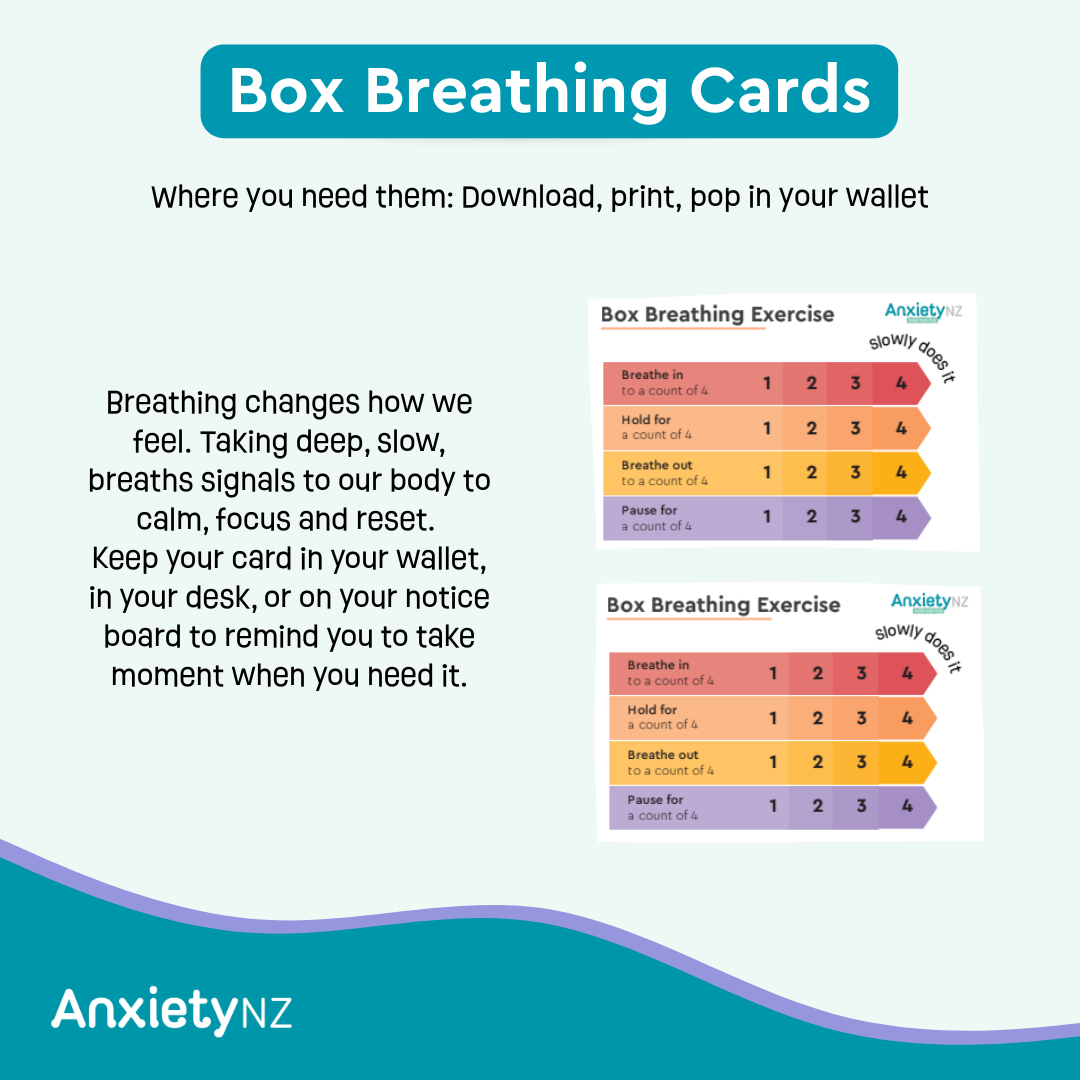
Would you like a simple, printable breathing practice you can keep close for moments of stress, overwhelm, or anxiety? Grab the Box Breathing Cards for free here.
The Empowered course is a free, self-paced course from Anxiety NZ to help you and your whānau navigate anxiety with proven strategies and support.