As artificial intelligence (AI) tools become more widely used for emotional support, questions are emerging about their safety and limitations. While AI offers promising breakthroughs, growing concerns from researchers, clinicians, and families highlight the need for careful consideration when using AI for mental health.
Registered Psychologist Goldie Hamilton recently wrote an article exploring the potential risks of relying on AI for mental health advice, particularly for people who may already be vulnerable.
Goldie suggests that AI is best understood as a tool that requires careful use. “I sometimes compare AI to a knife,” she explains. “In the right hands, it can be extremely useful. But used without care, or in the wrong situation, it can also be dangerous.”
While AI can generate supportive responses, Goldie emphasises that it cannot replace the human connection at the heart of effective therapy.
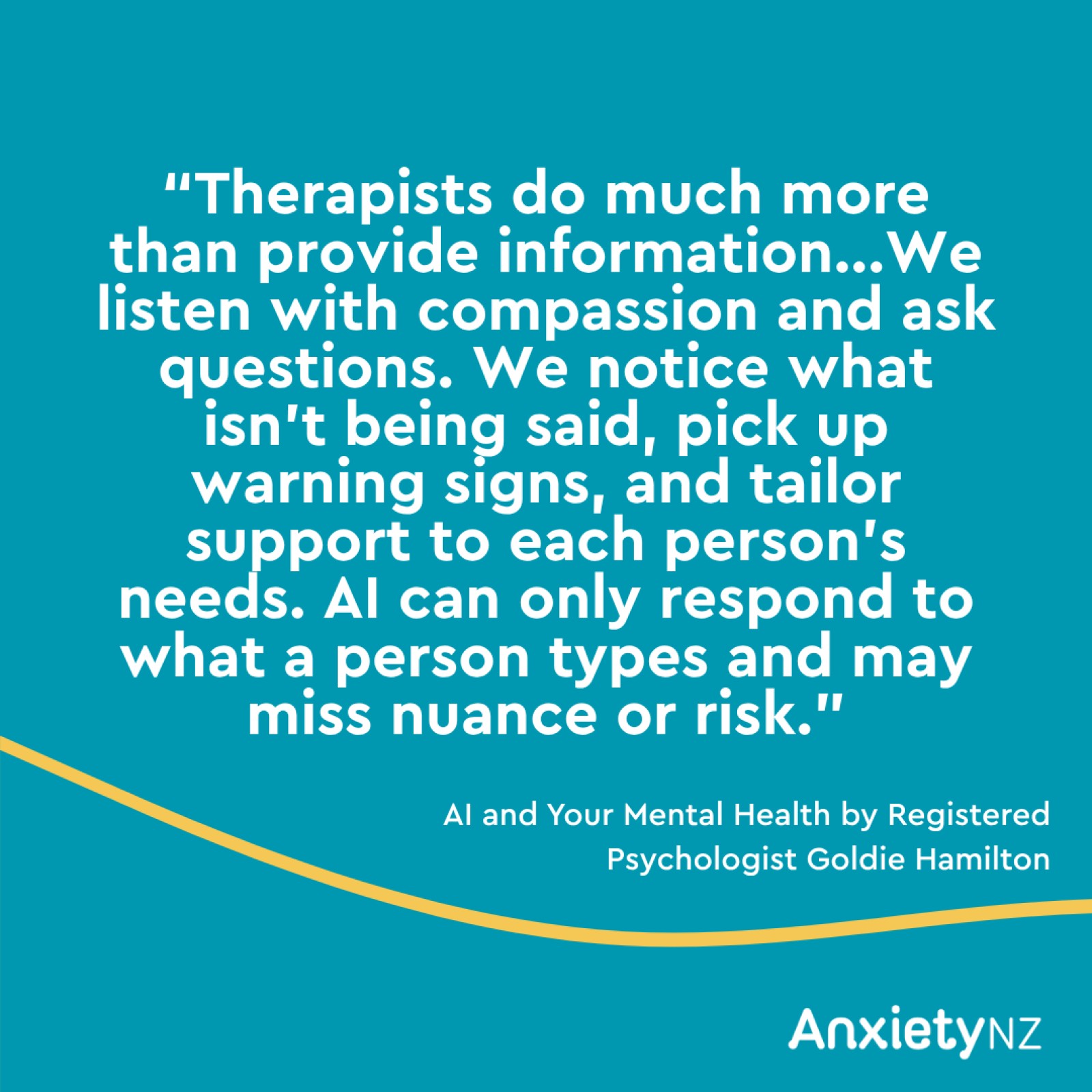
“Therapists do much more than provide information,” she says. “We listen with compassion and ask questions. We notice what isn’t being said, pick up warning signs, and tailor support to each person’s needs. AI can only respond to what a person types and may miss nuance or risk.”
Goldie adds that AI can simulate empathy, but it cannot offer the acceptance and care that help people feel truly understood and less alone during difficult times.
She also notes that AI's constant availability can undermine problem-solving and self-confidence, whereas therapy balances support with empowerment, helping people develop the skills to cope independently.
In her article, Goldie outlines groups who may be particularly vulnerable to harm from over-reliance on AI, including people experiencing anxiety, OCD, depression, suicidal thoughts, psychosis, low confidence, and young people.
She also proposes a six-question checklist designed to help people pause and reflect before turning to AI for mental health support:
1. Could AI’s mental health advice be unhelpful without me knowing it? AI responses can sound confident even when they are inaccurate or unsafe.
2. Am I seeking validation or reassurance about something personal? Repeated reassurance can reinforce recurring worries and self-doubt.
3. Does AI support appeal because I’m anxious about social interactions? Avoiding human contact can maintain or worsen anxiety and isolation.
4. Am I turning to AI because I fear being judged by a therapist? Human acceptance in therapy is often central to real healing.
5. Have I become dependent on AI mental health support? Over-reliance can weaken confidence and coping skills.
6. Has my well-being deteriorated while engaging with AI for mental health? A key check on whether AI use is helping or harming overall well-being.
“If someone finds themselves answering ‘yes’ to any of these questions,” Goldie says, “it may be best to reduce or pause AI use and connect with a registered mental health professional.”
For people seeking support, Anxiety New Zealand Trust offers a range of services, including therapy, peer support groups, a free 24/7 national 0800 ANXIETY helpline, and practical information and self-help resources through our website.
Goldie encourages people who are concerned about their mental health to reach out for human support, including whānau, friends, and trained professionals, and to view AI as a tool to be used thoughtfully and with care.
Readers can explore these issues in more detail in the full article by Psychologist Goldie Hamilton: "AI and Your Mental Health: Handle with Care., “AI and Your Mental Health: Handle with Care,”
At Anxiety NZ, we’re committed to making quality mental health support accessible to people and whānau across Aotearoa New Zealand. Our counselling service is part of that commitment — offering a safe, supportive space to talk, reflect, and work toward your wellbeing goals — at an affordable cost to you (or fully funded for eligible low-income earners or those under 18).
Our counsellors are passionate, skilled, and in the final stages of their professional training. Supported by approved clinical and peer supervision, they bring warmth, insight, and fresh perspectives to their work with clients.
Whether you’re navigating anxiety, life transitions, grief, stress, or simply want someone to talk to, our counselling team is here to support you.
-medium.jpg)