In this article, we will explore ways to manage anxious thoughts.
You may like our previous articles:
How do I manage anxious thoughts?
We often feel anxious because of the thoughts running through our minds—not because there’s an actual threat in our environment. Our brain is wired for survival, so when it interprets certain thoughts as danger signals, it activates the body’s stress response, even if we’re completely safe.
The good news is that anxiety driven by thoughts can be reduced. By learning and practising tools to manage our anxious thoughts, we can reduce their impact and regain a sense of calm.
We’ll share some tools that many people find helpful. It’s important to approach these as skills to learn and practice. If something doesn’t work for you the first time, try it again in a different situation—or practice when you’re feeling more settled and ready to take on something new. Over time, these strategies can become powerful resources for managing anxiety.
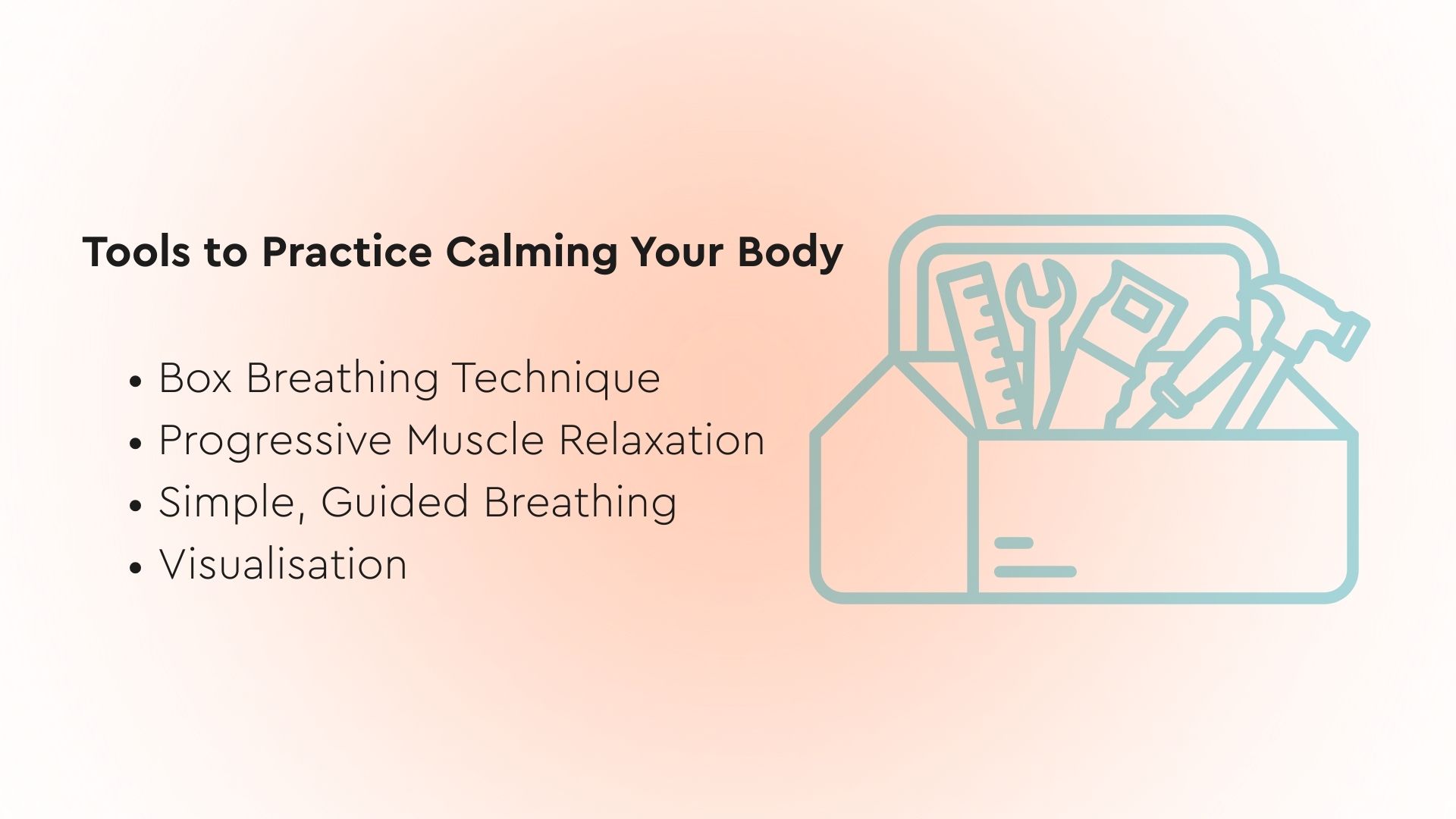
Challenge your thoughts
Ask yourself:
What evidence do I have that this thought is true?
What would I say to a friend who thought this?
Am I helpfully or unhelpfully trying to predict the future?
This helps you step back and assess whether your thoughts are fueling anxiety unnecessarily.
Reframe or replace negative thoughts
Try shifting your perspective:
“I can’t handle this” → “This is hard, and I’ve handled tough things before.”
“Everything is falling apart” → “This is a difficult moment, and it will pass.”
Consider Limiting Social Media and News
Sometimes, constant updates from social media or the news can make anxiety worse—especially during emergencies or when there’s a lot of negative coverage about the environment or climate.
If you notice that scrolling or watching the news is making you feel more anxious:
Give yourself permission to take a break.
Set boundaries, such as checking updates only at certain times of day.
Unfollow or mute accounts that increase your stress.
Remember, it’s okay to step away from your phone or computer. Protecting your mental wellbeing is important, and you can always catch up on important information later—once you feel ready.
Distraction and Grounding Techniques
Sometimes, the best way to interrupt anxious thoughts is to shift your focus.
Distraction techniques
These are helpful when you’re feeling overwhelmed:
Listen to music
Do something creative
Move your body (walk, stretch, dance)
Talk to someone you trust
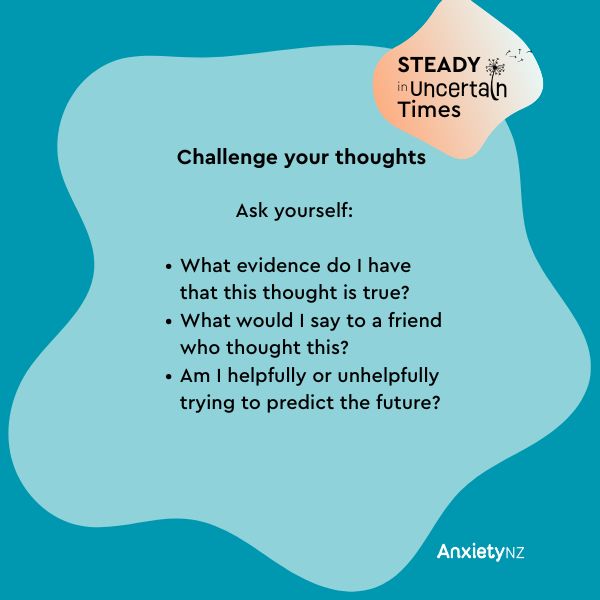
Grounding exercise
Use your senses to bring yourself back to the present:
5 things you can see
4 things you can touch
3 things you can hear
2 things you can smell
1 thing you can taste
This is especially useful during or after a stressful event.
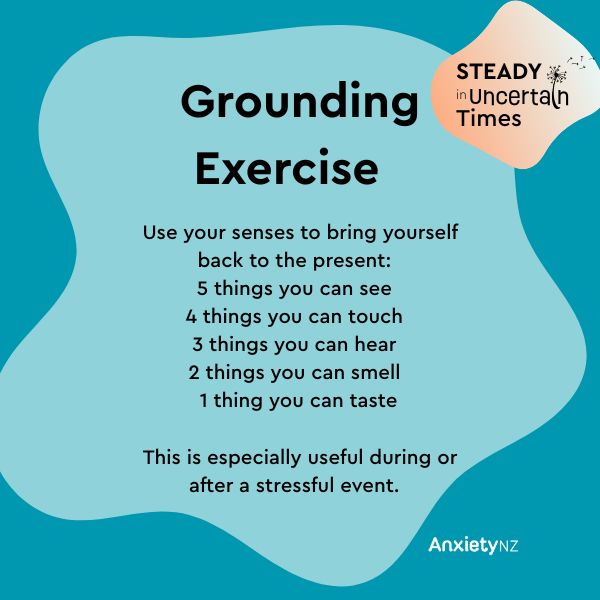
Calming the Body
Anxiety often shows up physically. These techniques help calm your nervous system:
Box breathing
A simple breathing technique to reduce stress:
Inhale for 4 counts
Hold for 4 counts
Exhale for 4 counts
Hold for 4 counts
Repeat the cycle 4 times.
This can be used during a stressful moment to stay steady.
If you’d like a simpler technique, try the long exhalation.
We have a Mindfulness Library full of techniques and tools like these, check it out here.
When Might Extra Support Help?
Many people experience anxious thoughts from time to time, and for some, self‑help strategies are enough to bring relief. For others, anxiety can feel persistent or overwhelming, even when they’re actively trying to manage it.
Extra support may be helpful if:
Anxious thoughts feel hard to switch off, or are affecting daily life
Worry is starting to impact sleep, relationships, work or study
You’ve tried managing on your own, but things don’t feel like they’re improving
Anxiety is accompanied by panic, low mood, or a sense of being stuck
Seeking support doesn’t mean you’ve failed to cope — it simply means you don’t have to manage this on your own. Talking with a trained professional can help you better understand what’s happening and find strategies that are tailored to you.
If you’re unsure what kind of support might be right for you, you can learn more about the options we offer here.
Need help now?
If you’re struggling with anxiety or just want to talk to someone, Anxiety NZ offers a free 24/7 helpline.
Call 0800 ANXIETY (0800 269 438)
We’re here for you—any time, any day.
Articles that you might find helpful
A personal story of what it's like to live with anxiety
Brief guided visualisation for supporting anxiety
Want to strengthen your own wellbeing, support someone who needs help, or build resilience to navigate life’s challenges? Steady in Uncertain Times is a free micro course designed for anyone experiencing anxiety related to climate change or weather events —and for anyone who wants to build their resilience.